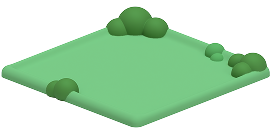
Cubipet
Your 9-5 Fitness Companion
Project Overview
Cubipet is an app designed for Apple Watch; that helps students and Gen-Z office workers ease into their new careers by game-ifying breaks. The purpose is to relieve the pain and health problems associated with sedentary workers, such as neck and back pain, migraine headaches, and eye strain.
Role: UX researcher, UX/UI designer
Project duration: 8 weeks
Programmes used:


Best Design Awards Winner 2024


AD23 Design Awards Winner 2023
Watch the video demo here

The Problem:
Currently, many office workers are facing the unwanted side effects of prolonged computer usage. University students are expected to be studying on laptops or leaned down over our textbooks. This leads to immense long term strain on our necks and upper back, causing chronic pain at alarmingly young ages. The age at which these symptoms begin to surface creeps lower as the years go by, and the younger generation is simply ‘ageing’ faster than they used to. It is no longer a problem only the older population have to face.
Aim:
This project is to inform and improve the lifestyles of individuals who suffer from health problems due to their occupation. In order to help and guide users to become more active during the day, I want to design game-like app/widget that is made for a smartwatch device.
Set up your app
so that it can give exercise tasks catered just for you

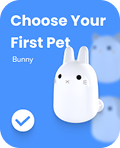
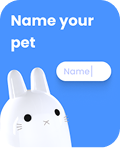


Great, now you're all set up!

Do tasks by yourself...
Or with friends


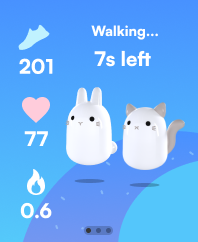
Walking...
15s left
Walking...
7s left


Final Prototype
The following is a show of the introduction screens, device set-up and the tutorial. New users will have to go through a tutorial showing how the app works.


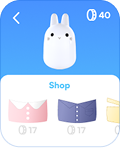
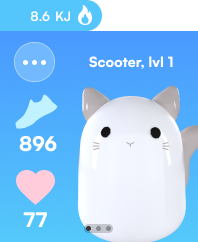
Set up, homepage, and landscape plains.


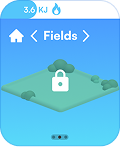
Set up, homepage, and landscape plains.


Boost feature example. Do activities together with a friend.



Development Process
01. Research
Research question: how might we encourage office workers to exercise more during their work day?
Sub-questions
-
Is it really beneficial to use a standing desk all day?
-
How does movement benefit our health more?
-
How do we motivate users to be more active?
-
How can gaming become an addiction?
-
Can addiction turn into a good thing, like motivation?
Current Situation
The NHS claims that prolonged sitting lowers the body's metabolism and hinders its capacity to control blood pressure, blood sugar, and fat breakdown (Posturite UK, 2022). Studies claim that certain types of cancer, heart diseases, and diabetes have been related to inactivity. Why it matters: Younger people are now experiencing all of the aforementioned health issues more commonly than in the past, making it essential to recognize and address this problem at an early age. All of this corresponds to prolonged computer and phone use, which, as previously indicated, causes neck and back strain.
Current Solutions

Standing Desks
Standing desks were the go-to solution around 2015-2020. People wanted to consider healthier alternatives to sitting. Many of these desks allows the user to adjust the level to their liking, making it a very flexible solution.
What works: standing up is better for our health than sitting. According to many research articles, it burns more calories and can even lengthen your life expectancy.
What doesn’t work: standing desks can be beneficial, but it is not good to do it for long as it can cause back or leg pain. Most people subconsciously distribute their weight onto one side, causing uneven pressure and strain on the pelvis and legs.
What I take from this: while this solution can be beneficial, it is more important to have long-term moderate movement throughout the day. This, paired with some occasional vigorous movement throughout the week, is what benefits your health.
Note. From BDIusa, by M. Weatherly, n.d. Copyright 2023 by Becker Designed.

Forest : Study App
Whenever you want to focus, you plant a tree. Watch the tree grow for as long as you study for, and soon you’ll have a forest. This is an app popular with students for studying, and the same principles can be applied to fitness in terms of positive encouragement needed to stay active.
What works: People like to see their efforts being recognised or visualised. In this case, their forest. It makes them feel accomplished. The aspect of growing collections also keeps people motivated. Tactile visual displays of their ongoing progress and achievements also help.
What doesn’t work: Some people might just give up and exit the app.
What I take from this: the concept of collecting achievements through the progress they make, showing their dedication to the work. This keeps people motivated as they would feel a sense of achievement seeing everything that they’ve worked hard on from one look at their forest.
Note. From Forest, by Unknown, n.d. Copyright 2023 by Seekrtech.

Activity App:
This app constantly reminds you to keep moving throughout the day. It has three “activity rings” that track your progress, and it encourages you to close them before the day ends.
What works: consistent, non-pressuring reminders for you to stand up for a few minutes if it detects that you’ve been sitting for too long. It is encouraging and not overwhelming. This app acts as an accessory to your life.
What doesn’t work: You can easily dismiss the notification and just ignore it. There isn’t an interesting concept to sustain engagement and the design is pretty simple.
What I take from this: the concept of collecting achievements through the progress they make, showing their dedication to the work. This keeps people motivated as they would feel a sense of achievement seeing everything that they’ve worked hard on from one look at their forest.
Note. From Apple, by Apple, n.d. Copyright 2023 by Apple Inc.
Design & Research Methods
Empathy Immersion Experience
The empathy immersion experiment was done so that we, the designers, could physically place ourselves in the user’s perspective. This would help us to better understand the experience, allowing us to design for the problems that come with it.
Office workers lack exercise and tend to have neck/back problems.

In my experiment, I sat at my desk working on my laptop from 9:00am to 5:30pm. Instead of freely taking breaks whenever I wanted, I stayed seated the whole work day and only took a thirty minute lunch break from 12:00 to 12:30. I finished the experiment by recording how I felt physically and emotionally.
How might we encourage office workers to exercise more during their work day?

I carried out user testing, namely A-B testing, made cardboard prototypes for role-play/assimilation, and conducted task-based testing. I gave the participant a scenario relevant to who would be using this app, then ask them to interact with the interface while making decisions in the eyes of that persona. This allowed me obtain a closer idea of how the app will perform in a real life context.
User Testing
I had interviewed several participants within the target audience group, and found that most people did deal with back, neck and shoulder pain despite being a very young age. This method was similar to conducting a survey, but the interviews allowed me to have a deeper understanding of the users and their circumstances by creating a conversation. I was able to dive further into learning about their lifestyles, work habits, exercise habits and their general feelings towards the product I was designing.
Interviews
User testing process


02. Target Users
Main User Group
The target users are Millennials and Gen-Z who are currently studying, entering the workforce, or already working in an office. This group ranges from office workers to university students. High pressure from work and study can also worsen their physiological state.
Exercise is proven to boost mental agility, motivation, energy, depression, and cognitive function, so it is very important that students get enough rest and exercise to maximise their full potential. Many also work part-time jobs, which adds another level of pressure.
For university graduates who are entering the workforce and are struggling to adapt to the restrictive lifestyle of office jobs, this app helps to ease them into the environment. Similarly, adults who have been in the workforce and still experience burnout may need a break from the repetition. This app acts as a much needed lifestyle changer for those who want it.

User Persona

NAME
Amanda Smith
AGE
36
OCCUPATION
Office worker
BIO
Amanda is starting to feel the repercussions of age setting in. She has an 8-year-old daughter whom she loves, but takes up most of her time and energy to care for her. She constantly struggles with joint and back pain, and her office job, which causes her to be immobile for most of the day, doesn’t help. She wants to take up yoga, but doesn’t have the time for it.
SCENARIO
Amanda has to focus her time at the weekends for her partner and child. She wants to start incorporating more exercise into her regimen, but is often too tired to do it before or after work. Ideally, she would want to incorporate it more into her daytime life, but often forgets to as she is so focused on her job. It would be nice to have a reminder to break away from her work every once in a while.
GOALS
- Fit more exercise into her daily routine.
- Not compromise the time with her family.
Amanda expresses her wishes to be a more active person, but is too busy. Her peers suggest a new gamified exercise app that caters to their professions. They all want to add her on the app.
Discovery
“Sitting at my desk all day is making me feel like I’m ageing two times faster.”
Market Cubipet to target audiences like Amanda and her peers/colleagues.
This app seems to fit perfectly into her lifestyle and fits her needs/goals upon seeing the targeted ads. The app’s tasks are scattered throughout the day and she thinks it is quite doable.
Consideration
“This app seems to fit my needs without needing to change my whole lifestyle. It also looks like fun.”
Amanda downloads the app to try it out and sets it up for her next day at work.
She sets up her app according to the on-screen instructions. She finds it is simple to follow along and enjoys the game-ified aspect of it, even wanting to challenge her peers.
Registration
"If I start to race my colleagues, this could get really fun, plus I'm burning calories."
Opportunity to introduce the app to all her peers.
Amanda is satisfied with her activity progress, and loves the community aspect of this app. She finds the leaderboard motivational as it creates a small amount of competition.
Onboarding
“I’m hooked into this, and I feel very satisfied about the improvement I’m making in my life.”
Amanda and her peers potentially become long term users, leave reviews and can be contacted for testimonials.

Needs
Thoughts
Opportunity
Feelings
Scenario 1: User downloads the app and starts to set up from the homescreen

Scenario 2: User is doing work and receives notifications/tasks


03. Ideation and development
Paper Prototypes
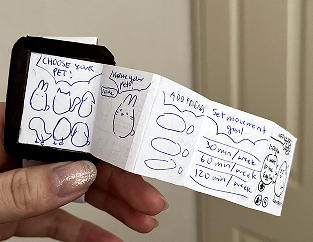
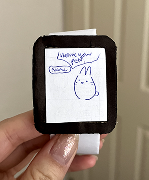
Before starting the wireframing process, paper prototypes were made to better grasp the process of designing an experience.

Development
Initially, the app's focus leaned more towards being a game rather than being a way to change your lifestyle. It was previously based on the pet’s wants and needs, prompting the user to perform activities for the pet, such as walking, feeding, and prompting them to interact with other users to motivate them to move.
Now, it is a fitness game-hybrid, and is less reliant on the user’s prior interest in gaming, slightly broadening the target audience.
For example, in the first screen to the right, there is a speech bubble with the words “I want to see Egglina!” in which the user would then have to stand up and walk to find the other user in the room who owns the pet, Egglina.




Low-Fidelity Prototypes
Intro and Set-up Screens
These are the intro and set-up screens. I started with very simple black and white wireframes to see what the general functions are going to look like. I prototyped these wireframes and conducted usability testing on them.


Pet selection screen. Choose your first starter pet.
Name your pet.
Keypad ‘scribble’ format for Apple Watch.


Add your contacts to complete fitness tasks with them.
Select your weekly exercise goals
Select your work/study hours to customise fitness tasks
Most feedback I received said it was easy to be lead through the interface. The main critique was on the confusion of how this app worked.
These are the main screens the user will be interacting with.
Home, Profile and Notifications

This is the homepage where you can see most of your stats, and your pet’s stats.

You can view more details of a pet when you visit their profile.

When the user is walking, the app detects it and automatically displays an animated walking screen.

You will receive periodic notifications of small tasks to complete throughout the day.
I started to bring in 3D elements, images and colourised the interface. I tested multiple colour schemes before deciding on blue and orange, however, I did change these colours later on.
Testing Colour Schemes, Mid-Fidelity


3D Sculpting Using WOMP Alpha
Hero Mascot Design
I created my own 3D characters to use as the main imagery in Cubipet.

Sculpting Animals And Areas
Using simple shapes such as spheres and cubes, characters and landscapes can be created with the help of the ‘goop’ tool, negative space tool and edge-rounding tool.

Conclusion
The process of designing a fitness app has provided me with an engaging investigation into the ways we can use technology to support our health. I learned about the complexities involved in turning an idea into a tangible, interactive application. This was possible through the careful application of research methodologies and processes.

There are currently very few solutions on the market, most of which have limited functions that aren’t necessarily useful for this specific context. I hope the envisioned possibilities of this fitness game can provide a meaningful impact on others’ lives and entertainment.